
Welcome to my first edition of ‘Cross Examination.’ I have 5 questions that I will ask of all my guests, plus 5 that are specific. There will be links for further information as well as miscellaneous details I may feel like sharing. Also, please keep in mind that I’ve read or watched or researched my guests and the topics so there maybe some information that I have that you may not. Hopefully this will intrigue you enough to look a little further into the subject, watch the film, read the book, etc. Please do not consider them spoilers. I would never want to ruin something for others. Also, if there is something I feel you should know in context, I will hyperlink to more information. Shall we begin?
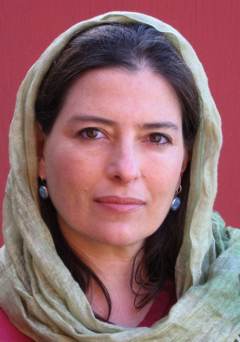
Justine Wearing a Hejab” | © 2007 | Promises Films
My first gracious guest is Justine Shapiro. She is a Jewish-American documentary filmmaker and the former host of Globe Trekker. She was nominated for an Oscar for her film Promises that took us into the lives of children living in the middle of the Israeli-Palestinian conflict in and around Jerusalem. She has a new film, Our Summer in Tehran that will air on public television stations around the country in April and May.
In Our Summer in Tehran, Justine and her 6 year-old son Mateo spend the summer with three middle-class families in Tehran, Iran transcending overt politics in favor of subtle, human, and often humorous moments. The 3 families consist of a religious family from the Revolutionary Guards, a cosmopolitan, secular family, and a single mom who is an actress. With no warning, they are given 48 hours to turn over their tapes and leave the country.
CW: How long were you in Tehran before being given the 48 hr warning to leave? Did you ever learn why you were asked to go?
JS:Mateo and I were in Tehran for about 7 weeks before we were told we had 48 hours to leave the country. There are different theories afloat about why we had to leave: I shot OUR SUMMER IN TEHRAN with an all Iranian crew and while we were shooting a member of my crew was brought into the Intelligence Ministry for questioning about a previous film that he had made. I don’t think that the Intelligence Ministry had any interest in me until they started to investigate my crew member. Perhaps then, the Intelligence Ministry looked further into who I am. They may have simply Googled my name and discovered that I had made a film (PROMISES) in Israel and Palestine. Iranian authorities are suspicious of people who work in both Iran and Israel.
CW: Did you keep in contact with the families? Did Leili give Sina to his father? How is Marjen? Did you feel as if the concept of taarof helped or hindered your project?
JS: Marjan Torabi, and I email one another regularly. She thinks my ex-husband Carlos (who is Mexican) looks like “Hezbollah” so she always inquires, “How is Mr. Hezbollah?” All the other families in our film are doing well, and Sina still lives with his mom, Leili. Taarof is part of life in Iran and I’ve found that all cultures have unique values and ways of thinking and communicating. One must be sensitive to this if we are to work together. In China, and in many other cultures, it’s very very important that people are not put in a position of ‘losing face.’ Working with and around taarof meant that I had to develop some dormant parts of myself.
CW: The scene at the mosque when you tell Marjen that you are Jewish was so beautiful, the fact that she was not fazed and spoke of Mohammad loving all struck me as a huge statement. Do you think most Americans realize that most Muslims are not terrorists, just as most Christians are not like Timothy McVeigh? Were you afraid to tell her or of what her response may have been?
JS: What I find really astonishing is that even with all the traveling I’ve done, even with all my first-hand experience, I, like most people, am brainwashed into seeing countries as the news media portrays them. But in actuality, every time I’ve told a Muslim that I am Jewish (with Palestinians in Palestine, with Iranians in Iran, with Egyptians in Egypt, with Moslems in India) I have never been rejected. On the whole, Muslims regard Jews as “people of the book. ” Even so, I was amazed at how nervous I was to reveal to Marjan Torabi that I’m Jewish. She is a deeply devout Muslim woman, and her husband, Dr. Torabi, works for the Revolutionary Guards. I thought that if Dr. Torabi knew I was Jewish he would bar his wife from spending time with me and participating in our film. I was not sure how Mrs. Torabi was going to respond and honestly I was very surprised, and so relieved, that she was so easy going about it.
Most of what we know about the world comes from narrow lens of the sensational and alarmist news media. That is our education. It is not through travel and direct experience that people understand the world. Hence, the stereotyping and the ignorance. In sadness I respond to you question: yes, I do think that many Americans conflate “Muslim” with “Terrorist.”
CW: At the end you speak of Mateo and how you hope he lives his life in wonder and not fear. Does he know what that summer was about? Does he still live in wonder?
JS: “Wonder” is imagination, the ability to go someplace in our mind’s eye. “Wonder” is being able to imagine possibilities. Mateo has traveled considerably, his father is Mexican and he’s spent a lot of time in Mexico City. He’s spent time in Brazil and Israel and in a refugee camp in the West Bank. I think it’s helpful for kids to have experiences that inculcate a sense of wonder. It’s a powerful experience for Mateo when he meets someone who doesn’t look like him or talk like him and he can make a connection regardless. Most of my crew in Iran didn’t speak English but they were so warm with Mateo and he loved hanging out with them.
Mateo has geographic sense of the world. We have maps all over our house, even our table mats are maps. I think that in part his sense of wonder is also a sense of the differences, and sadness, a sense that the world is not fair. Why do some people live in houses and others live in cardboard boxes? So “wonder” is not necessarily all smiles and joy, it can also awe at the mystery of injustice. We are all on this planet together, and yet we are leading our lives amidst wildly divergent circumstances.
CW: In Promises, you brought Israelis and Palestinian children together. Do you think that is the answer? Can children change the world? Did you see that kind of hatred bred into the children when traveling for Globe Trekkers? Do you feel that children can break the cycle of hatred/racism/bullying?
JS: Children are constant reminders of the future. Politicians have children and grandchildren. A child’s very existence serves to remind our leaders that their actions will have repercussions down through the ages. When Gorbachev and Reagan met in their historic peace summits, they talked about their grandchildren.
And when young children speak, unlike adults, they don’t self-censor. This is why I like to capture kids on camera when they are 8 to 11 years old. They are parrots, which means that oftentimes what they say is precisely what their parents would never say on camera. Children are guided by curiosity, more than by dogma or peer pressure. However once they hit 12 or 13 they are more inclined to say what they think is cool.
Once I heard Mateo say to a friend, about another kid at the school, “he’s so gay.” I wanted to rip Mateo’s head off, but instead I calmly asked Mateo what he meant by using the word “gay” as an insult. We talked about it.
In terms of bullying, I think that all of us possess the impulse to hate, to mistrust, to judge. That’s part of being human. The important piece is how do we behave? I think that as parents, we have to give our kids more space to express themselves. We can ask our kids tough questions, we can push them to think. Often it happens when I’m hanging out with my friends and I ask their kids a question, the parent will answer for them. We underestimate our kid’s intellectual potential. I also think that the intellectual and empathic potential is eroded as kids read less and less and ‘inter-act’ more and more with video games and other virtual forms of communication.
You can’t take the bullies off of the schoolyard. What happens in school happens in life. Bullying presents kids, their teachers and their parents an opportunity to learn how to deal with bullies. Of course there are those bullies who can literally torture kids to death, but I think those are exceptional circumstances. Some wonderful work around bullying can be found in the videos on-line. For example, the IT GETS BETTER campaign.
Words are powerful, and again I feel like the over dependency on virtual media deprives kids of another form of entertainment that builds imagination, empathy and vocabulary: books. Video games are inevitable and in many respects it is important for kids to learn the skills inherent in technology if they are going to be functional in society. But the use of screens is way out of balance.
I predict that as a result of this over dependence (often addiction) to technology we are going to see massive negative repercussions in the near future: not only in terms of neurologic development but we’ll see an even further decline in civil discourse.
And to return to your question, we did not bring the Palestinian and Israeli children together in PROMISES. We took Polaroid photos of each of the kids and we showed these photos to the kids. Some kids were interested in the kids in the photos and some weren’t. When we showed Faraj (the Palestinian boy who lived in the Deheishe Refugee Camp) a photo of the Israeli twins in their soccer outfits, Faraj asked to call them. He resonated with their interest in sports. Faraj invited the kids to visit him in the Deheishe Refugee Camp. Certainly had BZ and I not been there making the film, these kids would never had met. What we were able to do was be the bridge and facilitate this meeting.
*****
These are the questions I intend to ask all my guests.
CW: Have you been bullied or discriminated against? If so, please explain. Have you ever bullied or discriminated against others? If so, explain.
JS:When we first moved to Berkeley California I was in the 2nd grade in an integrated elementary school. I had come from an all white elementary school in Rochester NY. Berkeley was one of the first school districts in the US to make school bussing mandatory and the Berkeley schools were integrated. The first day of class we each were asked to say where we were born. I said I was born in South Africa. Well the kids just didn’t believe me. A white girl born in Africa??!! No way! Not possible! This was in 1970. I went outside for recess and group of kids ganged up on me and tried to beat me up. I was terrified. My teacher, Mrs. Duda, showed a map of Africa to the class and pointed to South Africa and explained that white people lived there too. Still, the kids at recess taunted me “You are a liar, you lie you lie!!!” But they didn’t physically threaten me after Mrs. Duda showed the map. My mom told me that some of these kids, who were black, were maybe jealous that I got to say that I was born in Africa and to understand that they were confused to see a white girl say she was from Africa. I just remember my mom trying to give me their perspective. The irony of course is that my grandparents moved to South Africa in the early 1900s to escape persecution in Lithuania.
CW: Can intolerance be fixed? If so, how?
JS: Intolerance is a natural feeling. We have to accept that all humans, every one of us, from time to time, have less than noble impulses. And where is the safe place to express politically incorrect views? On the battlefield? We need to create safe spaces for young people to vent their prejudice, their judgments, their hate and ask questions: in these spaces its vital that there be knowledgeable facilitators responding thoughtfully and factually. School environments are the ideal place to ‘teach tolerance’ since in many urban schools the student populations are diverse. Speaking across perceived divides takes skill and courage. I think that schools need to make time for these dialogues.
CW: What inspires you to want to change the world? (person, book, quote, etc) What is important to you?
JS: Having a son inspires me to work towards making this world a more loving generous place. I want my son and all children to live in security. My inspiration comes from embarrassment and recognition of my own ignorance. I am amazed at how narrow my own thinking is about other cultures. Regardless of all the traveling I’ve done, books I’ve read, films I’ve seen, conversations I’ve had, I often think about a place and a people in the most stereotypical terms. When I realize how small minded I am than I am inspired to make a film or do some work that examines that view. As I examine this area of my ignorance I try to share that process so that other can benefit from my exploration. This is what I tried to do with both films, PROMISES and OUR SUMMER IN TEHRAN and as host of GLOBETREKKER.
CW: What would you like to accomplish in your lifetime or have as your epitaph?
JS: Accomplishment: She donated 5 billion dollars to literacy programs.
Epitaph: She lost those last 5 pounds! [that made me giggle]
CW: What should we know about you?
JS: I recently tested positive for the BRCA2 gene mutation otherwise known as the “Ashkenazi breast cancer gene” which predisposes carriers to increased risk of Ovarian and Breast Cancer. I am sharing this with you because in this case, knowledge is power. If you know women with a history of ovarian and/or breast cancer, and if they are Ashkenazi Jewish, you may want to learn more about this gene mutation. Here is a wonderful website dedicated to women who face increased risk of cancer due to this gene mutation FORCE is the only national nonprofit organization devoted to hereditary breast and ovarian cancer. Their mission includes support, education, advocacy, awareness, and research specific to hereditary breast and ovarian cancer. Their programs serve anyone with a BRCA mutation or a family history of cancer.
To learn more about the film click here.
To find out when it is airing in your neck of the woods, check here. If your city is not listed, please keep checking back.
You can ‘like’ the film as well as learn more details on Facebook here. Please let Justine know how you found her and what you felt about this interview.
A huge flood of gratitude to Ms. Shapiro for being my first interview here. I am so appreciative and love how it all came together. Thank you, Justine.
Next month, civil rights icon, Ruby Bridges. If you are unfamiliar with her, look her up, read her book, see the painting Norman Rockwell did. Do it. Now.
Now, let’s discuss. Remember I am Cop’s Wife and do not remain silent, but I will throw it to you, the jury - how do you feel about the topics we addressed? Have anything you would like to add? Do you have guests you would like to see interviewed?


A great interview! Do you take suggestions for future subjects?
People of Ashkenazi Jewish decent are also twice as likely as the non-Jewish population to develop Crohn’s disease. That doesn’t seem fair. Their genes are bullying them!
Great interview! Love all your questions.
What an incredible woman. Thanks for sharing!
Excellent! Excellent, excellent, EXCELLENT!! ((hugs))
Thank you for the great conversation. Keep up the great writing.
This was such a great interview. I loved the questions that you asked Justine Shapiro. It is interesting how she still can stereoptype cultures even though she is a world traveler. What a concept. I know I have traveled the world, but not the middle east and I do have stereotypes (mainly because I am a woman). I would be also surprised that a muslim would be okay with someone that is Jewish. It’s funny to me that anywhere I go in the world and tell them I’m from Texas, people (even Americans) believe that I live on a farm like in the TV show Dallas and ride horses to schools. I live in Houston, which is one of the five largest cities in America. I remembered getting yelled at in California, because I didn’t have a typical southern accent and I just said that most people in Houston do not have strong southern accents; we are metropolitan.
I’m doing my own traveling in England for 12 days, to just get away. I am interested to know what that will bring as far as breaking stereotypes even though I have lots of English friends, love English television shows/movies/comedians, etc.
I might try to watch Promises and a Summer in Tehran. Both sound interesting.
To the above commenter: Yes, I can’t believe that kids at that age know about the rainbow and the symbolism, but live in that day in age.
It seems ironic, but fitting that your post popped up on email right when I got home from my kids’ school. I was called in by the principal b/c my daughter was being teased this morning and was very upset. She made a t-shirt last night w/ her and her best friends’ name on in and a rainbow in a triangle. I didn’t think that kids in 6th grade would equate that to “being gay” but they apparently did. My poor daughter had no idea what they were talking about. Thankfully, she is fine, but seeing your post and reading your interview w/ Ms. Shapiro was a wonderful way to bring my blood pressure down and think about kids of all cultures. I applauded you when you got “famous” and I applaud you now. I’m looking forward to catching Ms. Shapiro’s movie which I may not have known about if it wasn’t for you! Thanks!